FORT JEFFERSON MEMORIAL CROSS
The Story
THE FORT JEFFFERSON MEMORIAL CROSS
A PLACE OF HISTORY AND REFELCTION
The story of the Cross at Wickliffe began in 1937 when a few members of a community choir, spearheaded by Mrs. Noah Geveden, erected a small wooden cross on a hill at the Ancient Buried City—now known as the Wickliffe Mounds Research Center—in Wickliffe, Kentucky.
In 1951, Mr. and Mrs. Noah Geveden furnished the materials to construct a 35-foot pole with cross arms to replace the smaller cross. Bill Howle wired the cross with 325 bulbs, which were illuminated each year during Easter and Christmas.
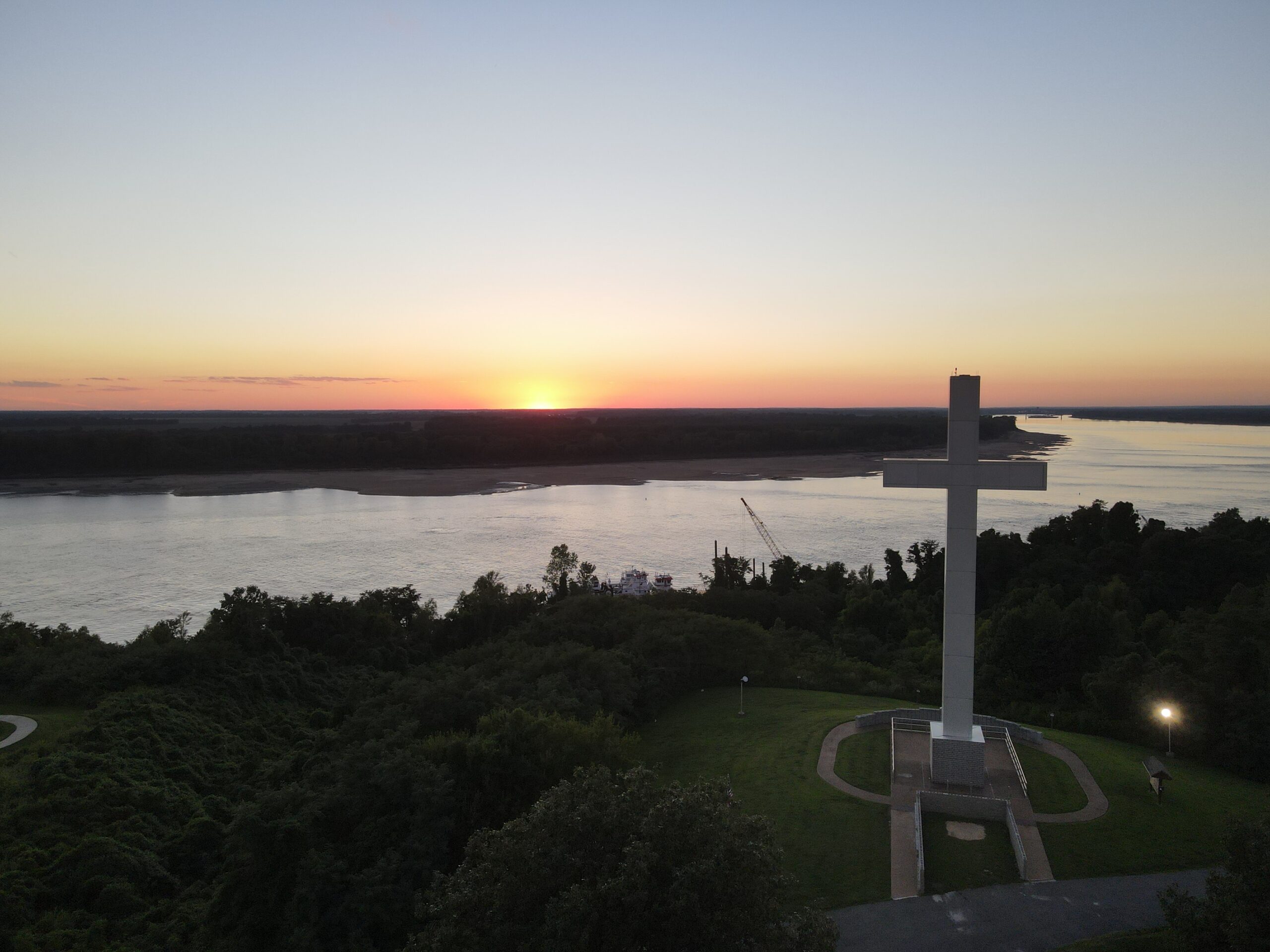
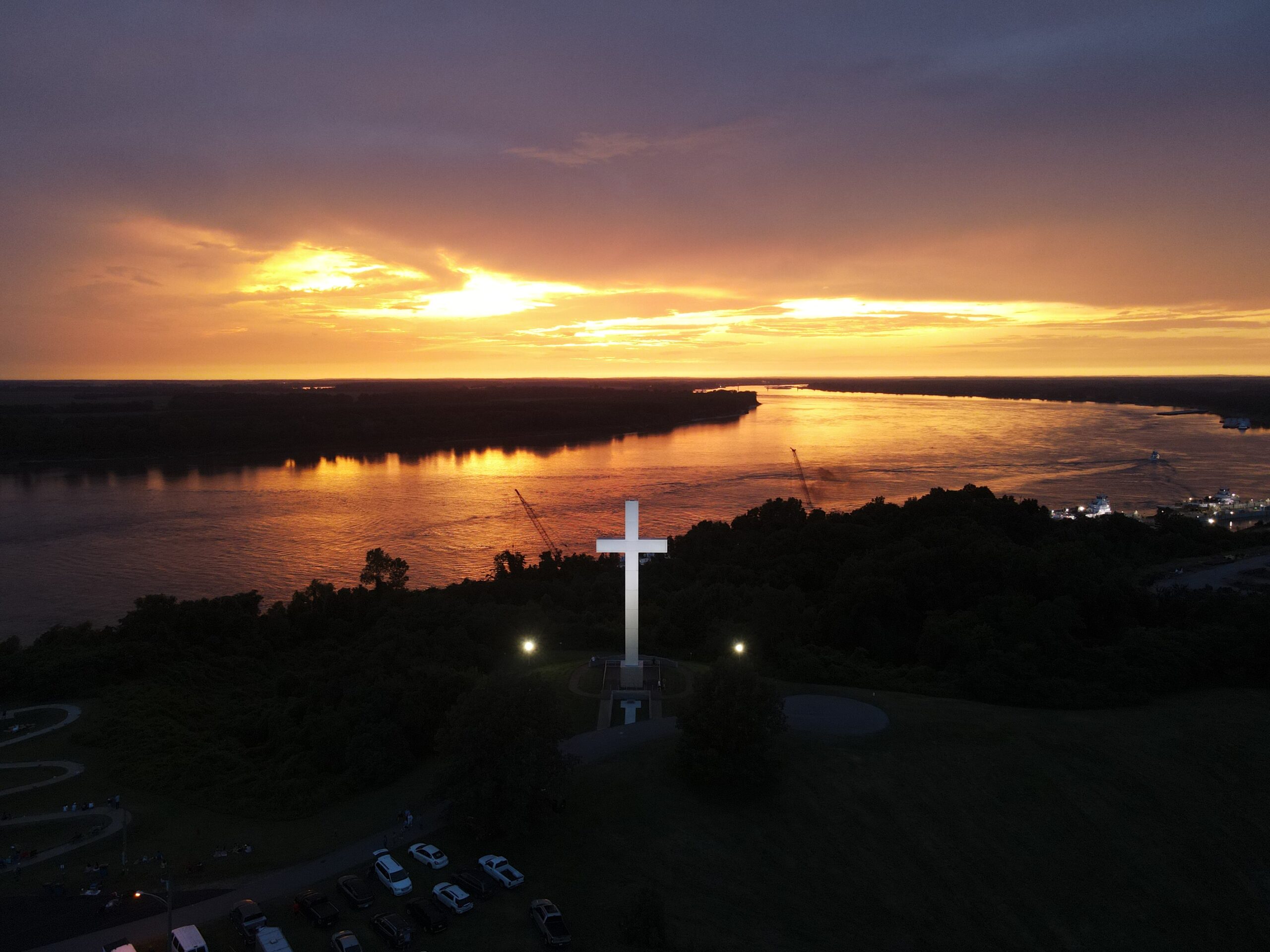
When Murray State University purchased the property in 1981, it became necessary to seek a new location for the cross. It was during this time that the vision emerged to build a cross tall enough to be seen from the tri-states of Missouri, Illinois, and Kentucky. The proposed cross would stand 90 feet tall and be illuminated at night for all to see.
Site selection took considerable time. The highest point along the river was Fort Jefferson Hill, and in 1989 the 38-acre property came up for auction. Several citizens, encouraged by Margaret Phillips—who was terminally ill at the time—asked the Wickliffe City Council to purchase the tract and lease or sell two acres for the memorial cross. The City Council purchased the property on July 26, 1989.
The name for the memorial was chosen through public suggestions. Juett Owens Jr. of Wickliffe proposed the name Cross at the Confluence, reflecting both its location above the confluence of the Ohio and Mississippi Rivers and the idea of citizens from the tri-states “flowing together” to support the project. The word Memorial was later added when it was decided the cross would honor the memory of loved ones.
Representatives from all 51 churches in Ballard County were invited to serve on a county-wide committee. The first meeting was held at St. Mary Catholic Church in LaCenter on March 8, 1990, with Rev. Jack Studie, pastor of Faith Baptist Church in Wickliffe, presiding. Twenty-three churches were represented.
A board of directors was selected: John Wood, Chairman; Tom Juett, Treasurer; Joyce Carpenter, Secretary; and directors Terry Simmons, Anita Howle, Richard Overby, Peggy Piper, Carolyn Rosenstone, and Teresa Sullivan. Keith Kelley was later added to the board. The board met on November 7, 1991, at the Barlow House Museum to finalize the design and materials. Soil borings confirmed the site would support a 90-foot freestanding cross, and a fundraising goal of $150,000 was established.
By February 22, 1992, the project had raised $21,762 through memorial gifts, church and group donations, aluminum can collections, and events such as a “Cross Walk.” A major fundraiser launched on Easter 1992 involved selling engraved granite bricks to be placed around the base of the cross. The bricks, sold for $100 each, could be purchased in honor or memory of loved ones. The base allowed space for 800 bricks.
Groundbreaking took place on May 22, 1994, with coverage from local television and newspapers. The project was completed in two phases. Phase I involved construction of the foundation and surrounding deck and was designed by Simmons Engineering of Paducah. The contract was awarded to Bass Maintenance of Wickliffe on August 16, 1994, and completed on October 28, 1994. Phase II included construction of the 90-foot cross.
In March 1995, Earnest Brown laid the first bricks around the base of the cross pedestal. By that time, $98,954 had been raised. By December 31, 1996, 823 bricks had been sold, reaching the original fundraising goal of $150,000.
Due to rising construction costs—which eventually doubled to approximately $300,000—the board secured a loan from Citizens State Bank in the fall of 1996. With faith and determination, board members co-signed the note, and Phase II was completed on April 4, 1999.
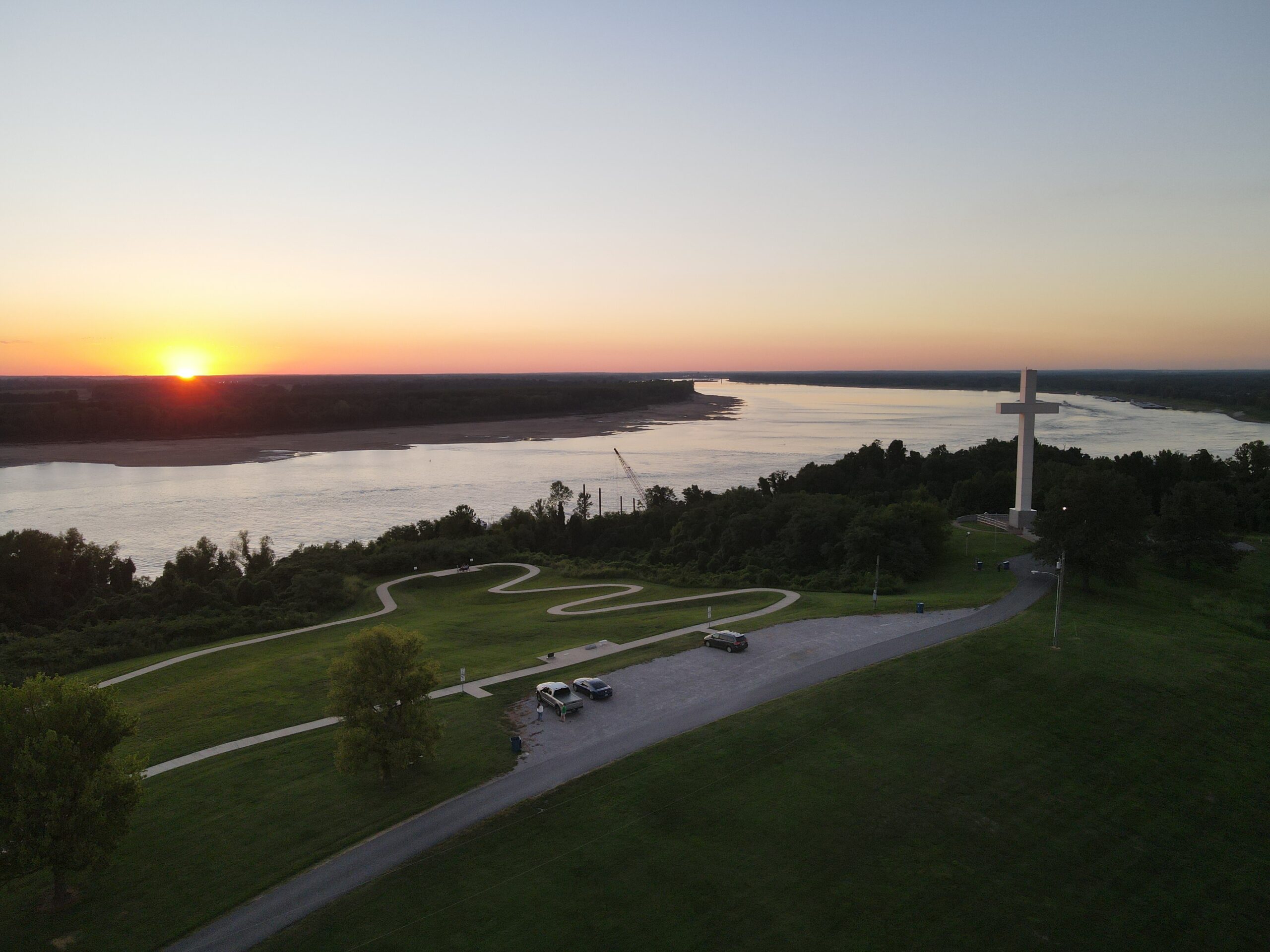
As additional bricks were sold, a walkway was constructed around the outside of the deck to allow for a brick wall. Jerry Dunn Construction completed this expansion in 2000.
On August 29, 2002, the board voted to make the final loan payment, officially retiring all debt. In total, $316,405 had been raised to complete the project.
Today, the Cross at the Confluence serves many purposes. It has hosted weddings, memorial services, annual Easter sunrise services, and candlelight vigils, including services held in remembrance of September 11. In addition to its spiritual and memorial significance, the site has become a regional landmark and popular tourist attraction, drawing visitors traveling Highway 51 and the Great River Road. Perched high above the confluence of two great rivers, the illuminated cross stands as both a symbol of faith and a point of reflection for residents and travelers alike.